


To Lift or Not to Lift
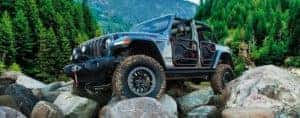
Ground clearance is an essential part of off-roading, and it looks imposing as well. As an off-road-focused brand, Jeep features many vehicles that already put a significant amount of distance between the bottom of the chassis and obstacles on the ground. That said, production vehicles meant to be easy to drive on the road can only go so far in the ground clearance arena, meaning there is space for the aftermarket to try and improve the factory vehicle’s capabilities. That said, the stock height of a Jeep, especially a modern off-road specialist like the Wrangler, has already been set at the perfect height for the majority of owners. Your needs must deviate significantly from most owners to make a lift worth it. So, when it comes to a lifted Jeep vs a stock Jeep, which is best for you?
Stock Height
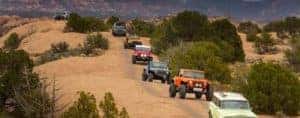
All Jeeps begin at the stock height, but there is some variation even in this most basic of categories. Different Jeep models have vastly different purposes they are made to excel at. A Compass, for example, is almost solely meant for street driving, and as such, has an almost car-like amount of ground clearance. By contrast, the Wrangler is a machine built to hit challenging trails quite literally right off the showroom floor and sits much higher off the ground.
Even in the Wrangler lineup alone, there are significant differences in equipment offered between the more multi-purpose and the more off-road focused trims. Practically everyone will find almost exactly what they need right out of the box in one type of Jeep or another. And not only will that factory setup be the easiest to attain and maintain, but it will also be more reliable than nearly any custom suspension setup.
Stock height is the best for daily driving, and certain models of the Wrangler, such as the Rubicon, offer a stock ride height that can tackle nearly any trail with ease. If one wants a lift just to show off, stock height certainly isn’t going to turn more heads than normal, but unless one is looking to do some serious crawling off the beaten path, some variation of stock height will likely be enough.
High Lift:
At least for the sake of easy classification, let’s designate any lift over eight inches as a “High Lift.” That kind of lift can often require extra modification so that the drivetrain still works as designed, and in general, is the most extreme kind of lift one can apply to a production vehicle.
In terms of daily driving, running errands on the street, and parking, a high lift can be impractical at best and dangerous at worst. Some of the problems a lift like this presents are curbed by modern technology like the backup cameras ubiquitous on modern vehicles, but a lift this high handicaps their usefulness by putting them so high off the ground that certain immovable objects could be under their field of vision. The biggest problem with a high lift on a daily driven vehicle is a dramatically increased risk of rollover. A high lift is so tall that a Jeep’s track width can’t be widened enough to compensate, meaning cornering at any kind of speed could lead to a serious accident.
Even on the trail, a vehicle this tall would often have more problems than triumphs. While you will have enough ride height to drive over almost any obstacle you may encounter on the trail, the increased height of the Jeep would cause new issues. The rollover risk would be increased even further by undulating terrain, and without an almost complete drivetrain and suspension package to complement the lift, the newly lifted Jeep wouldn’t actually have the flexibility required to take advantage of that new lift.
Completely changing out the drivetrain and suspension to match the eight-inch plus lift would indeed create a cartoonishly capable off-road vehicle, which would be something akin to a production-based King of the Hammers racing rig. But in practice, the number of people who need such extreme capabilities is very small, even among dedicated enthusiast groups. The vast majority of people who pursue a lift like this do so without changing any other components required to make it useful, as they really just want the highly lifted look and nothing else. Those individuals certainly get the look they are going for, but don’t be near them when they try to drive with any urgency.
Medium Lift:
For the purposes of discussion, let’s call a Medium Lift a ride height increase of four to eight inches. This is a wide swath that covers most serious lift kits. Depending on where in the spectrum a lift kit lands, its effects could range from being mildly dangerous on the road to not making any large difference in road manners. Likewise, the kits at the top tend of the medium bracket, when paired with appropriate suspension geometry tweaks, can genuinely turn an already capable off-road vehicle into something of a monster while retaining at least a semblance of on-road safety and comfort.
Lifts that range around six inches further tone down the pros and cons of the modification, and those just over four inches can be done without large drawbacks. While a high lift tends to be pre-owned by those who exclusively pursue the biggest and baddest looking modifications, regardless of how embarrassingly impractical they are, medium lifts are a more practical choice. They offer some of that look while not requiring a complete suspension package just to make that lift worthwhile as an actual performance modification.
Low Lift:
A low lift of four inches or less provides the best so-called bang for the buck. Not just in terms of cost and ease of installation, but in terms of effect. Small lifts accentuate a vehicle’s look and performance while staying close to the factory parameters, meaning very little else needs to be modified in order for the lift to improve vehicle performance. There are many who believe that bigger is better, but those people have never tried to drive along the side of a hill in a poorly modified high-lifted Jeep. Big imposing lift kits are useless on their own, while smaller lifts can allow one’s Jeep to access places it couldn’t before without undue expense or modification issues. It also helps that there is not much more risk of rollover with a low lift.
Go Out and Lift Your Jeep
When deciding on modifying any kind of vehicle for any discipline, the first thing you should consider is your own needs and goals. Is your Jeep purely for the road, or do you plan on hitting the dirt? Once you’re out in the wilderness, what kind of off-road experience are you looking to have? A stock Jeep is surprisingly capable, especially once the driver gets some experience off-roading.
That said, one size doesn’t fit all, and that attitude is part of the Jeep ethos. Whether you just want to have some off-road fun with friends or build the most extreme off-road machine around for competition, a Jeep, especially a Wrangler, is the ideal base. No matter what catches your interest, plan ahead and remember to spend more time on the trail than in the garage.

